


00For decades, global logistics was designed around an almost unquestioned assumption: the world was moving toward ever greater integration. Globalization promised efficiency, lower costs, and supply chains optimized down to the millimeter. Today, that assumption no longer holds.
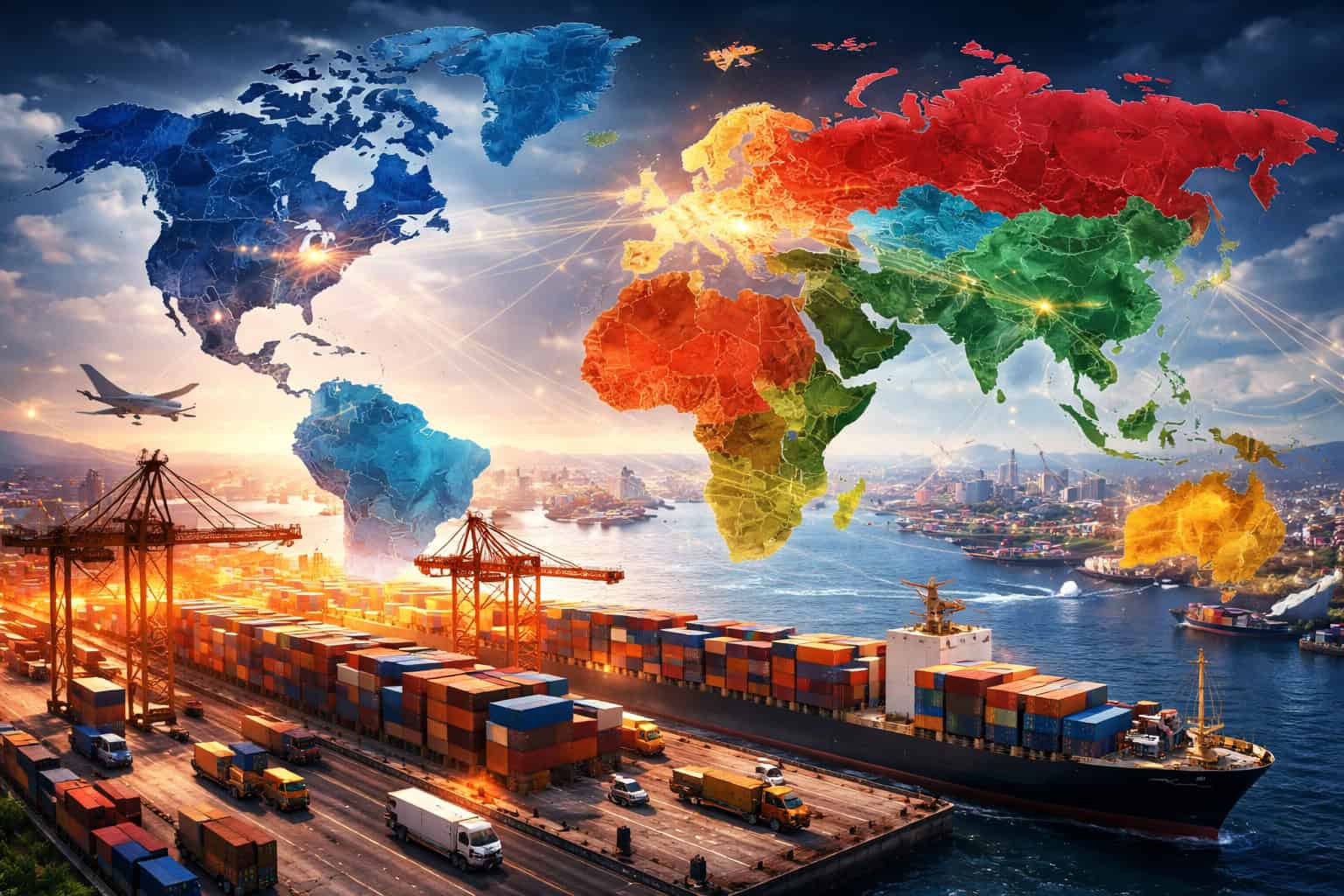
Geopolitical fragmentation is not a temporary anomaly or an uncomfortable pause on the road back to a “normal order.” It is the new structural context on which the architecture of global logistics is being rebuilt. And with it, the rules of the game are changing.
This article explores how regional blocks, conflicts, sanctions, and protectionism are forcing supply chains to prioritize resilience over pure efficiency, and why logistics can no longer be managed through spreadsheets alone.
From a flat world to a fragmented world
International trade is no longer organized on a single global board. Today, it looks more like a mosaic of blocs, overlapping interests, and functional borders that switch on or off depending on the political context.
Tensions between major powers, the reconfiguration of strategic alliances, trade wars, economic sanctions, and armed conflicts have introduced a variable that used to be treated as exceptional: structural uncertainty.
In this new scenario, logistics chains no longer fail only because of operational accidents, but because of geopolitical decisions made thousands of kilometers away. A regional conflict can shut down a key corridor. A sanction can render critical suppliers unusable. A political decision can turn an efficient route into an unbearable risk overnight.
The consequence is clear: a logistics model designed exclusively to maximize efficiency is no longer enough.
Why 74% of Supply Chain Leaders Now Fear Geopolitics Most –
Regionalization vs. globalization: a false dilemma
We are not witnessing the end of globalization, but its reconfiguration. The dominant trend is not isolation, but strategic regionalization.
Companies are redesigning their supply chains around logics such as:
- Nearshoring: bringing production closer to end markets.
- Friendshoring: prioritizing allied or politically stable countries.
- Multisourcing: avoiding critical dependence on a single supplier or region.
This shift is not driven by ideology, but by a pragmatic reading of risk. Excessively long and concentrated supply chains are efficient until they are not. And when they fail, they fail systemically.
Regionalization introduces a new equation: companies give up part of their cost efficiency in exchange for greater control, predictability, and responsiveness. In other words, extreme optimization is traded for robustness.
The truth about LNG –
Route redundancy as the new normal
or years, redundancy was seen as inefficiency. Why duplicate routes, suppliers, or infrastructure if one well-optimized option was enough?
Today, that logic has become obsolete.
In the current context, redundancy is not a luxury but a strategic requirement. Having alternative routes, backup suppliers, and contingency plans is no longer a “just in case” measure, but a minimum condition for operational survival.
This means accepting an uncomfortable truth for many traditional financial models:
resilient logistics costs more, but not having it costs far more.
Companies that have not incorporated redundancy are exposed to abrupt disruptions, production stoppages, contractual breaches, and loss of market trust. By contrast, those that have invested in flexibility are better able to absorb shocks and reconfigure quickly.
The hidden cost of “logistics security”
One of the biggest analytical mistakes is to view logistics security only as an added expense. It is a hidden cost that was always there but was previously not accounted for correctly.
When a supply chain is designed solely around the lowest unit cost, risks are externalized in ways that do not show up in Excel:
- Excessive dependence on an unstable region
- Vulnerability to sanctions or regulatory changes
- Lack of visibility over second- or third-tier suppliers
- Slow reaction times in the face of unexpected crises
Geopolitics has made these latent costs visible. It is no longer just about how much it costs to move goods, but how much it costs not to be able to move them when the context changes.
Logistics security does not eliminate risk, but it makes it manageable. And in a fragmented world, managing risk is just as important as optimizing margins.
Why logistics can no longer be optimized with Excel alone
Excel was (and still is) a powerful tool. But it was conceived for a relatively stable world, where variables changed gradually and predictably.
Today’s logistics operates in a radically different environment:
- Abrupt geopolitical shifts
- Complex interdependencies between infrastructure, energy, data, and transport
- Decisions that must be made in real time and with incomplete information
Optimizing logistics today requires systemic thinking, not just calculation. It requires integrating geopolitical intelligence, scenario analysis, dynamic risk assessment, and continuous adaptation capabilities.
Excel’s New AI Agent Does Your Job For You –
Logistics as a strategic discipline
The major transformation now underway is not only technical, but cultural. Logistics is ceasing to be merely an operational function and is becoming a first-order strategic asset.
In this new paradigm:
- Resilience competes on equal terms with efficiency
- Decision-making incorporates political and geostrategic variables
- Supply chain design is conceived as a living process, not a fixed structure
Organizations that understand this shift will not only withstand crises better but will also be able to turn complexity into competitive advantage.
Because in a fragmented world, the winner is not the one who optimizes the most, but the one who adapts best.
Accepting the new map
Geopolitical fragmentation is not a transitional phase. It is the new framework within which global trade, and with it logistics is being redefined.
Continuing to operate under the assumptions of the past is a silent form of vulnerability. Rethinking logistics architecture through resilience, redundancy, and strategic intelligence is not a defensive option: it is a leadership decision.
The question is no longer whether the world will go back to the way it was.
The question is who is designing their logistics for the world as it already is.
