


For years, one of the main goals in logistics was to achieve visibility. Knowing where a shipment was, how much inventory remained available, which supplier was accumulating delays, or which route was beginning to show problems represented a major advantage compared with operating with fragmented or outdated information. That scenario has changed.
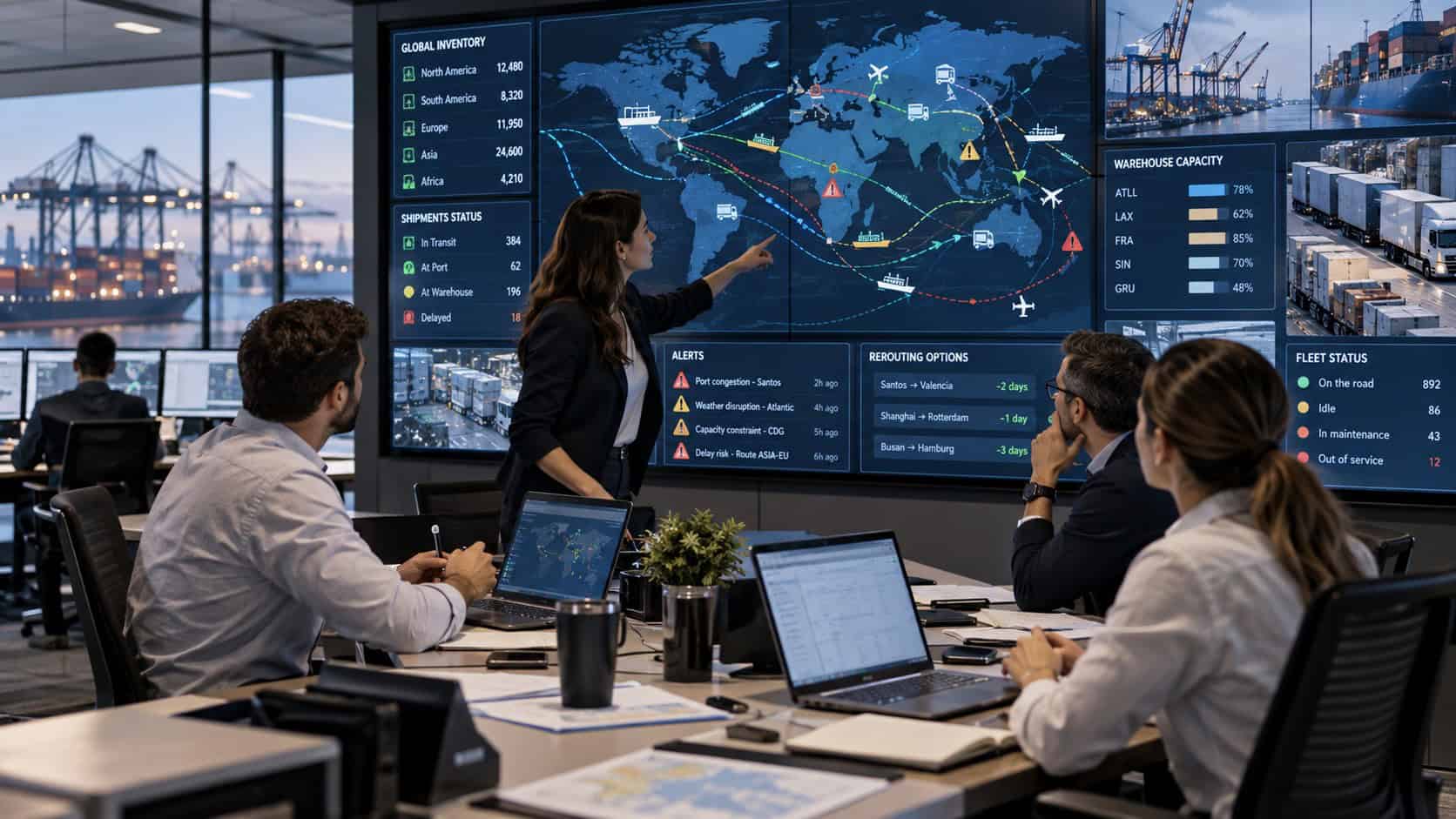
Today, many companies already have access to data in almost real time. They have dashboards, alerts, tracking systems, and multiple indicators showing what is happening across their operations. However, having more information does not necessarily mean making better decisions.
This is precisely where the new challenge for Control Towers, or logistics control towers, lies.
Their most important evolution is not about displaying more data, but about reducing the distance between detecting a problem and acting on it.
What is a Supply Chain Control Tower?
From integrating data for visibility to being able to intervene in real time
The first generations of Control Towers focused on integrating information from different systems. Transport, inventory, suppliers, production, and orders could all be visualized on a single platform.
This represented a major step forward because it made it possible to build a more complete view of the operation.
Then came alerts. The system no longer simply showed what was happening; it began to flag deviations: a delivery at risk of delay, a stock level below expectations, a congested route, or a supplier failing to meet agreed deadlines.
The next step is much deeper: moving from detecting an exception to actively managing its consequences.
A truly advanced Control Tower should help identify alternatives, assess their impact, and coordinate the execution of the decision. If a critical supplier is delayed by several days, for example, simply displaying an alert is not enough. The real value emerges when the system can determine which orders will be affected, which customers have the highest priority, whether inventory is available at other locations, which alternative routes are possible, or how much it would cost to expedite certain shipments.
Information therefore stops being the end point and becomes the starting point for decision-making.
From Analytics to Action: Kinaxis’ Supply Chain AI
When reporting is no longer enough
One of the problems with many Control Towers is that, in practice, they still function as sophisticated reporting systems.
The charts are better, information is more centralized, and indicators are updated more quickly. However, once an incident is detected, the organization still depends on phone calls, emails, meetings, and manually coordinated decisions across different departments.
Technology can provide information in seconds, while the company may take hours to react.
That is why true transformation is not simply about connecting data. It also requires reviewing how decisions are made.
A Control Tower needs clearly defined responsibilities, priority criteria, escalation protocols, and levels of autonomy. Without these elements, even the best visibility system can end up producing nothing more than a long list of alerts.
The risk is clear: moving from having too little information to having too much information that nobody turns into action.
From monitoring incidents to orchestrating decisions
The key word here is orchestration.
In a complex logistics operation, a decision rarely affects a single element. Changing a route may reduce a delay but increase costs. Moving inventory from another warehouse may protect service levels but leave another region with less availability. Changing suppliers may keep production running but introduce new quality or compliance risks.
The role of a modern Control Tower is to help understand these interdependencies. This can mean comparing alternatives and their consequences before executing a decision. It can also make it possible to automate certain responses when previously defined conditions are met.
Some decisions will still require human supervision, especially when they involve high costs, strategic customers, or major operational changes. Others may be executed automatically within established limits.
The key is not to remove people from the process, but to enable them to intervene where they genuinely add value.
Manifest Vegas: Q&A with FourKites’ Sree Mangalampalli
The supply chain is a living network, not a linear chain
This evolution also challenges the way we imagine the supply chain itself.
The expression “supply chain” suggests a linear logic: supplier, factory, warehouse, transport, distribution, and customer. Today’s reality looks much more like a network. Suppliers, logistics operators, production centers, warehouses, ports, airports, carriers, digital platforms, and customers interact simultaneously. A change at any point can create consequences elsewhere in the system.
A delay at a port can alter the inventory available at a distribution center. That inventory shortage can affect certain orders, change transport planning, and ultimately impact commercial commitments.
Logistics therefore behaves like a living system.
Managing it requires more than observing each element separately. It requires understanding the relationships between them and being able to reconfigure flows as conditions change.
The imperative of making decisions at the speed of operations
Another important change has to do with time.
Many companies still organize their decisions around periodic cycles: weekly meetings, monthly reviews, or established planning processes.
Incidents, however, do not follow a calendar.
A storm can alter a shipping route within hours. A road can close unexpectedly. A supplier can report a production problem. Demand for a product can change suddenly. The ability to react quickly therefore becomes an essential part of logistics competitiveness.
This is why Control Towers are increasingly evolving towards exception-based management models. Operations that are running correctly continue on course, while attention is focused on situations where a relevant deviation occurs.
Artificial intelligence and advanced analytics can strengthen this capability by identifying patterns, anticipating potential impacts, and proposing alternatives before a problem becomes more serious.
The objective should not be to generate more alerts, but to reduce the time between four key moments: detect, understand, decide, and act.
The real advantage lies in turning information into action
Visibility will remain fundamental. Without reliable, connected data, it is impossible to build truly agile logistics operations. But visibility is beginning to become a basic requirement rather than the ultimate competitive advantage. The difference will lie in the ability to transform that information into operational decisions and execute those decisions quickly.
The most advanced Control Towers will stop being large screens from which the supply chain is observed and become genuine coordination and orchestration centers. The change may seem small, but it is profound: moving from knowing what is happening to being able to influence what happens next.
Because in real-time logistics, the advantage is no longer in seeing the problem first, but in acting before the problem decides for us.
