


When we talk about the future of logistics, the images are usually spectacular: warehouses full of robots, autonomous vehicles, drones flying over cities or robotic arms preparing orders without human intervention. However, a much less visible part of the logistics transformation may be having a far greater impact.
It is happening in the cloud.
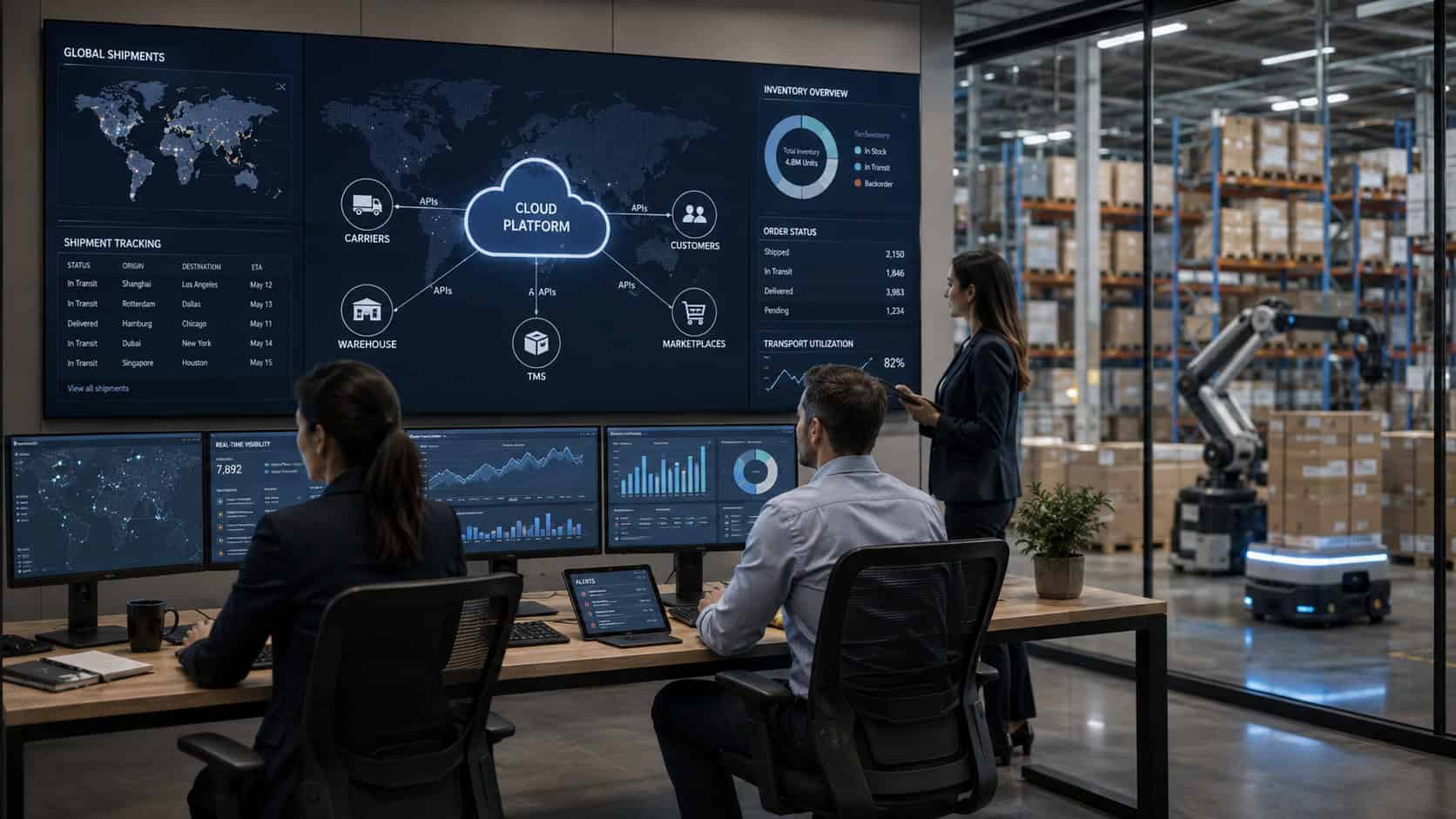
The real technological leap in logistics does not consist solely of automating the physical movement of goods, but of enabling companies, platforms, warehouses, carriers and customers to exchange information and react in real time.
To achieve this, two technologies are particularly important: cloud computing and APIs (Application Programming Interfaces).
Robots can speed up an operation. Cloud and APIs can connect the entire system.
How Huawei Cloud helped Ninja Van build a smarter, scalable logistics operation for the future. –
The problem with logistics built on closed systems
Logistics has been exchanging information digitally for decades. One of the most widely used mechanisms has been EDI (Electronic Data Interchange), which made it possible to replace numerous paper documents with structured electronic messages.
For years, it represented an enormous improvement. The problem appears when we try to apply an architecture designed for relatively stable relationships to a much more dynamic logistics ecosystem.
Today, a company may work simultaneously with multiple logistics operators, marketplaces, suppliers, carriers, visibility platforms, customs systems, external warehouses and customers distributed across different countries.
Each new connection may involve specific configurations, data formats and processes.
The result is a kind of digital web where adding a new supplier, changing operators or incorporating a new tool can become a technology project lasting several months.
EDI is not disappearing and continues to be essential in many operations, but in certain scenarios it no longer provides the necessary flexibility.
And that is precisely where APIs come in.
APIs: the new common language of logistics
An API allows two systems to exchange information and perform actions in a structured way.
A simple example: when an online store shows a customer where their order is, it is probably not manually checking the carrier’s system. Its platform automatically sends a request to another application and receives updated information.
That exchange can happen thousands of times every minute.
Applied to logistics, the possibilities are enormous.
A company can check transport availability, request a rate, generate a label, book a pickup, receive the location of a shipment, update inventory or report an incident practically in real time.
But their real value does not lie solely in automating these tasks.
APIs make it possible to turn logistics into a connectable ecosystem.
Instead of building a rigid technology integration for every business relationship, companies can create architectures where new operators, services or platforms can be incorporated much more quickly. Integration stops being solely an IT project and begins to become a strategic capability.
Leaps in Logistics | Where the Internet Lives
Cloud: much more than moving servers
Something similar is happening with cloud.
For years, many conversations about cloud migration focused on a technical question: where are our servers hosted?
But the real value of cloud for logistics does not simply consist of moving infrastructure from an in-house data center to one managed by a provider.
Its value lies in agility.
A cloud architecture makes it possible to scale capacity when demand increases, deploy applications in different regions, process large amounts of information and connect digital services much more quickly.
Think of an e-commerce campaign that multiplies orders for a few days, a geopolitical crisis that forces routes to be recalculated or a port disruption that affects thousands of deliveries.
In these scenarios, the technology infrastructure must be able to absorb changes quickly.
The cloud makes that flexibility part of the architecture.
Combined with APIs, it also makes it easier for different specialized applications to work together: transport management systems (TMS), warehouse management systems (WMS), visibility platforms, artificial intelligence engines, forecasting tools or order management systems.
Logistics can therefore move away from depending on one large monolithic system and evolve towards an ecosystem of connected capabilities.
Before automating, you have to connect
This idea also changes the conversation about automation.
Buying robots for a warehouse can improve productivity, speed or accuracy. But if those robots operate within processes disconnected from the rest of the supply chain, the overall impact will remain limited.
A highly automated warehouse does not by itself solve the problem of inventory information arriving late, transport working with different data from sales or an incident taking hours to propagate across systems.
Physical automation works much better when there is first a digital architecture capable of connecting it.
That is why, in many cases, the sequence should be: connect, integrate, automate and then optimize.
Not necessarily the other way around.
Oracle Connected Logistics –
The danger of moving old processes to the cloud
However, migrating to cloud does not guarantee transformation either.
There is a common risk: moving exactly the same existing processes, dependencies and technology structures onto more modern infrastructure.
In other words, changing the technology without changing the logic.
If a company needs twelve approvals to change a route, the cloud does not eliminate those twelve approvals.
If different departments maintain contradictory databases, an API may even accelerate the circulation of inconsistent information. And if onboarding a new supplier requires weeks of internal decisions, having scalable infrastructure adds relatively little.
That is why a transformation based on cloud and APIs should also begin with organizational questions.
What information should flow in real time? What decisions could be automated? Which systems should share data? Where do manual processes that create delays still exist? Which actors need access to which information?
Technology architecture must support process redesign, not replace it.
Logistics is becoming a digital network
The future competitive advantage of many logistics companies will not depend solely on the number of warehouses, vehicles or robots they have.
It will also depend on how easily they can connect with others.
A company capable of quickly incorporating a new operator, adding an artificial intelligence platform, integrating customer data or reacting to a disruption will have an advantage that is difficult to achieve through physical automation alone.
Robots will continue to be fundamental. Warehouses will become increasingly autonomous and transport will incorporate new forms of automation.
But beneath all that machinery there will be something far less visible making coordination possible: cloud infrastructure, data and APIs constantly exchanging information.
Perhaps that is why the next major logistics revolution will not look like a robot.
Before making machines move faster, we need to make sure that the entire logistics ecosystem can speak the same language.
