


What would happen if a strategic port closed for three days? What if the closure lasted two weeks? What if, in addition, fuel prices rose, a critical supplier reduced its capacity and several customers brought their orders forward at the same time?
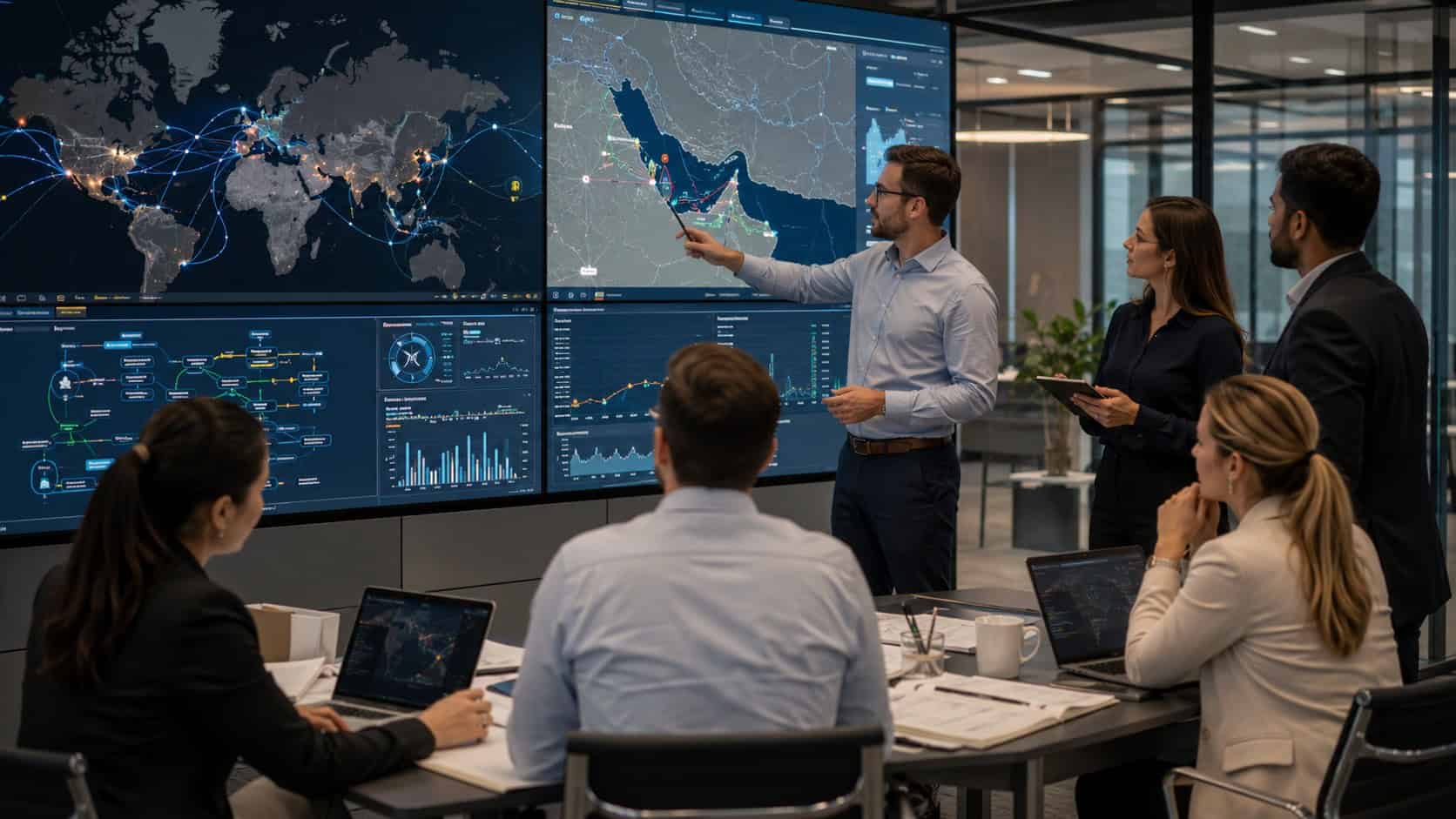
Traditional logistics planning generally tries to identify the most likely outcome. It analyses historical data, seasonality, average transit times and demand patterns to build a forecast.
The problem is that supply chains no longer operate in stable environments.
Geopolitical conflicts, extreme weather events, regulatory changes, material shortages, port congestion and sudden shifts in demand can be combined in ways that are difficult to anticipate.
Faced with this reality, the strategic question is no longer simply what we believe will happen.
The question is: are we prepared for what could happen?
This is where a new way of understanding predictive supply chains emerges. Not as a machine capable of guessing the future, but as a system that combines artificial intelligence, data and simulation to explore several scenarios before the organization must face them.
https://ignasisayol.com/en/can-an-ai-agent-predict-the-next-crisis-in-the-strait-of-hormuz/
The limits of a single forecast
A linear forecast usually builds one central version of the future: expected demand, an estimated delivery time or an optimal inventory level.
This approach remains useful for organising day-to-day operations. However, it is insufficient when the environment breaks with known patterns.
A route may have worked for years and stop working overnight. A supplier considered stable may suffer a disruption. A rise in energy prices may turn an efficient solution into an excessively costly alternative.
Scenario planning follows a different logic.
Instead of projecting a single course of events, it considers different plausible futures. For example:
- Operational continuity with moderate delays.
- Frequent but short-lived disruptions.
- Prolonged interruption of a route or supplier.
- A simultaneous increase in costs, demand and restrictions.
- Regional fragmentation of the supply chain.
The aim is not to determine exactly which one will occur. The aim is to understand how the organisation would respond to each possibility.
From data to strategic questions
Artificial intelligence can process large volumes of information from orders, inventories, suppliers, routes, weather, energy prices, maritime traffic and economic indicators.
It can also identify anomalies and detect changes that are not yet evident to teams.
However, data alone does not indicate which decisions should be made.
For example, tools such as MarineTraffic make it possible to observe vessel movements; UKMTO publishes maritime security alerts; and Windward analyses behavior and risks in maritime transport.
These sources may reveal a reduction in traffic, longer waiting times or a change in the risk level of a route such as the Strait of Hormuz.
But the relevant question for a company is not only what is happening there. It is what it would mean for its own logistics network if the situation lasted 48 hours, ten days or a month.
This is where prediction becomes strategy.
Digital twins: testing decisions without putting operations at risk
Digital twins make it possible to build a virtual representation of the supply chain.
This model may include suppliers, production centres, warehouses, inventories, transport capacity, routes, costs, orders and service levels.
Its main value lies not in visualising the operation, but in experimenting with it.
A company can use a digital twin to simulate what would happen if a supplier stopped operating, a port closed temporarily or demand rose unexpectedly. It can also compare different responses.
What would happen if safety stock were increased? Would it be better to change supplier or split production among several suppliers? How much would it cost to use air freight for priority products? Which customers would be affected first?
The digital twin allows these decisions to be tested before they are applied.
In this way, planning ceases to be a static projection and becomes a laboratory of possibilities.
Incorporating Digital Twin Technology in Port Operations: Md. Tanvir Hasan & S.M. Abu Nahiyan Miah –
Not the best decision, but the most robust one
In a stable environment, a company can optimize its chain to achieve the lowest cost, the smallest inventory or the shortest lead time. In an uncertain environment, that same optimization can create fragility.
A network designed to work perfectly under a specific set of conditions may fail when any of those conditions’ change.
Scenario planning introduces a different idea: the goal is not always to find the optimal decision for one specific future, but the most robust decision across several possible futures.
An alternative supplier may be slightly more expensive but reduce dependence on a single region. A somewhat higher inventory level may reduce financial efficiency but protect the continuity of a plant. A route may not be the fastest, but it may be the most stable.
Predictive supply chains do not eliminate these tensions. They make them visible before decisions must be made under pressure.
From forecasting to preparing
An alert is of little use if the organization does not know what to do with it.
For anticipation to have an impact, each scenario must be linked to concrete actions.
If the risk of delay increases, a review of delivery dates can be triggered. If a supplier exceeds a certain exposure level, the search for alternatives can begin. If a route reaches a critical threshold, capacity can be reserved in another corridor. This requires clear protocols, responsibilities and decision criteria.
It also requires coordination across operations, procurement, finance, sales, technology and management.
Artificial intelligence can detect signals. Models can simulate consequences. But the organization must decide which risks it is willing to assume and which capabilities it wants to build.
The future of logistics is designed
Predictive supply chains are not about developing a perfect forecast.
They are about reducing the distance between a signal of change and a useful decision.
Data makes it possible to observe. Artificial intelligence helps to interpret. Digital twins allow organizations to test. Scenario planning turns all of this into strategic preparedness.
A truly anticipatory company does not wait to discover the next crisis before deciding how it will respond.
It tests alternatives, identifies vulnerabilities and prepares capabilities before they are needed.
The future of logistics is not guessed: it is designed by testing today the decisions that could protect the entire supply chain tomorrow.
